Saturday, November 22, 2008

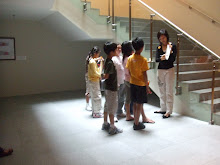
My Story at National Musuem of Singapore - 21st Nov 2008

Dear Parents, Here are some photos we have taken during the HandsonLearning Workshop, "My Story" at the National Museum of Singapore. For more information on the workshop, please visit us at http://www.handsonlearning.com.sg/ or email us at info@handsonlearning.com.sg.


Friday, November 14, 2008

Practical Tips for Positive and Joyful Learning (Part II)

During our previous issue, we talked about how to create a positive learning environment. Today, we will share with you some tips on how to encourage your child to enjoy learning and become a lifelong learner.

Ten Tips for Encouraging Joyful Learning

Parents can make learning into a truly joyful experience. By injecting some creativity and thoughtfulness into your child’s learning experience outside the classroom, you can develop your child into a self-motivated and engaged learner.

a) Making your child’s study more inviting: Adding more colourful murals, changing colour of the lightings, putting comfortable chairs and hanging colourful curtains could transform a sterile study room into an inviting space to learn and study.

b) Finding pleasure in learning: Once you have redecorated your child’s study, you should learn more about his/her interests. Your involvement and efforts to tailor his/her learning to these interests could motivate an entirely different kind of learning, where motivation comes from within and no outside force or coercion is required. For instance, if your son loves cars, think about how to weave cars into his learning process. One way is to use the speed of his favourite car and your family car to teach him mathematic concepts of speed, distance and time.

c) Creating things: Children like to make things – By allowing them control over their work and creating something original using their minds and hands, they achieve a tremendous sense of pride and achievement. It also empowers and encourages the child. For instance, if your child likes drawing and painting, get him/her to paint a picture or make a craft as a gift for family members or friends. To build your child's imagination further, you can encourgae him/her to write a story or poem based on his/her artwork and include them in a gift card. Whether it’s a painting, a model or a powerpoint presentation, you should inspire and encourage your child bring his/her own ideas and creations to life.

d) Showing off good work: When your child has done good work, don’t be shy to ask him/her to share it with your family. If he/she has drawn a beautiful picture, you may want to put it up in the wall in the study room or in the living room. If he/she wrote a touching story, you may want to ask him/her to recite it to your family after dinner.

e) Taking time to experimenting: By keeping students at their desk most of the time, listening to lectures, reading textbooks, filling out assessment books, schools sometimes stifle the grand ideas that are innate in young children. You can help your child re-ignite his/her creativity by allowing him/her experiment with hands-on activities or encouraging him/her to try different methods to solve the same problem. Using different objects or work of arts to explore different perspectives will also help your child expand his/her learning capacity and willingness to experiment. During this school holiday, try surfing the web and look for simple experiments to conduct together (one good idea will be to build a solar-powered microwave oven).

f) Letting your child choose: You can help your child by allowing your child to pursue his/her interests outside classroom. It is possible to promote joy in learning when there is some ownership. Instead of planning what activities he/she should take up, try listening to his/her interests and allow him/her to pursue these interests. Similarly, during holidays, instead of packing him/her off to memory enhancement programmes or more tuition, try letting him/her decide the topic. You can then help shape his/her ideas into purposeful inquiry-based learning. This sense of ownership will not only motivate him/her to learn, but also help nurture his/her curiosity and find joy in learning.

g) Reading good books: Everyone loves a good story - by immersing your child in a culture of good books, you can surround him/her with joy. Students today already have tons of reading to do from school. You can help your child pick up reading by encouraging him/her to read books just for pleasure, including not so serious genres, such as action-adventure books, fantasy, or even non-fiction on topics he/she loves.

h) Going outside: Students today spend an inordinate amount of time in school, tuition centres or enrichment programmes. Sometimes, your child may need to take a break and take in some fresh air. During weekends, instead of packing your child off to his/her tuition classes, take a field trip and bring him/her outdoors. The botanical garden is a good place to get close to nature and at the same time, learn about science and biology. For younger children, Jacob Ballas Children’s Garden is a good place to visit. For older children, it is not inconceivable to let them plan a weekend trip out for the family, allowing them to learn about responsibility at the same time.

i) Offering different activities outside the classroom: Professor Howard Gardner’s work on multiple intelligences has illuminated parents and educators on the uniqueness of each child and the need to provide opportunities to use their varied strengths and interests. Unfortunately, in our efforts to improve test scores and to get into good schools, we tend to de-emphasis non-academic activities, such as physical education and humanities. If your child has a special affinity for visual arts, music, theater or sports, remember to leave some time for him/her to participate in these activities and let him/her experience some joy.

j) Having fun together: Being a parent is a tough job, but if you can create a joyful learning environment for your child, you can also experience the joy in teaching them and learning with them. You can also create a stronger bond by having fun learning together.

By Ms Angeline Tong and Ms Brenda Yeow

Thursday, October 30, 2008

Practical Tips for Positive and Joyful Learning (Part I)

In this issue, we take a break from the “Helping your child excel in the 21st century” series to bring to you some practical tips to develop a positive learning environment for your child and inject joy into his/her learning. Parents may find these tips useful while planning activities for the upcoming school holidays or preparing for the new school term.

Before we discuss the guiding principles for crafting a positive learning environment, it is important to understand the power of words. What you say to your child and how you say it is critical in creating a positive learning environment for him/her and allow your child to maximise their learning potential. For this week’s entry, we will be focusing on the use of communication to create a positive learning environment.

Take a moment to reflect on the times when you were a student – how did your parents and teachers talk to you? What kind of words did they use and what were their tones? Did that make you feel motivated or insecure, and even angry? As parents, it is critical to understand that your words would shape your child’s learning. According to research by renowned developmental psychologist, Vygotsky, words can affect your child’s learning in the following ways:

a) Affecting a child’s sense of identity: imagine how a child would feel if he really likes singing and a parent, instead of offering praises and encourage, asks the child why he is so noisy and wasting his time on singing and not on his maths homework

b) Helping a child understand how he/she is doing: naming a specific attribute could actually help your child develop his/her interests or talents. For instance, if he/she drew a very nice picture, you may want to encourage him/her by specifically naming an attribute that really attracted you – for instance, you can praise him/her on the vivid colour combinations

c) Influencing parents’ relationship with a child: To a child who has just quarreled with his cousin, one can say “stop quarrelling with your cousin or I will punish you” or one can ask “I saw you quarrelling with your cousin. Can you let me know what had happened?” The latter would build a trusting parent-child relationship versus the former, which is one based on threats.

Five Guiding Principles for Positive Communications

How then can you ensure that your words support your child’s learning and create a positive environment? There are several guiding principles that can help you:

a) Using a kind, straightforward tone and be direct: It is important to say what one mean, but in a kind tone. Avoid sarcasm or indirect comparison to win compliance. Sarcastic language like, “ which part of sitting down and keeping quiet don’t you understand” will embarrass a child and create mistrust and resentment. Instead, you can be firm and just tell the child to sit down so that everyone in the family can enjoy the show together.

b) Focusing on actions: Focusing on action will point towards desired behaviours rather than attitude or character. This is especially important for young children, who tend to be concrete thinkers and may not be able to understand abstractions. An example of an abstraction you may want to avoid is to tell your child to be respectful. Instead, ask him/her to treat others with kindness by helping their friends when they fall down or carrying shopping bags for their grandparents.

c) Keeping it brief: Young children find it hard to follow long sentences. More often than not, before you finish your long sentences, your child will be thinking about other things and have lost focus. Thus, it is important to speak in shorter sentences to allow your child to absorb and understand what you are saying and expecting.

d) Using silence: Using silence after asking your child questions could actually help him/her craft a more thoughtful response. While a 3 second pause may seem very long, it allows an open space for your child to think, rehearse what to say, and can solicit a higher quality response. This also teaches your child that a true listener will attempt to understand the other party’s questions, before formulating a better response.

e) Expressing confidence in your child: If a parent is able to demonstrate faith and confidence in the child, he/she will be more likely to live up to the parent’s expectations. Spare no effort to notice and comment on positive behaviour in a calm tone. Be specific in your observations, such that it will provide hard evidence on why your child should believe in himself/herself.

Look out for our next entry in a fortnight’s time, where we will be sharing with parents, ten tips for encouraging joyful learning in their children.

By Ms Angeline Tong and Ms Brenda Yeow

Thursday, October 9, 2008

How to help your child excel in 21st century? Part II

How to Help Your Child Excel in the 21st Century – Part II

Educating your child beyond core curriculum – Mastery of 21st Century Themes

In part 2 of our series, we will discuss how parents can help your child develop important life skills as you help complement the core academic foundations, that is well tackled by our current education system. While the Ministry of Education in Singapore has long realized the importance of “Life Skills” and has been actively redesigning the curriculum to incorporate the inculcation of such skills into our children’s education, parents can play a much bigger role in developing these skills outside of mastery of core subjects.

As we have discussed during our previous post, there is an urgent need to weave multi-disciplinary themes in the 21st century into your child’s learning. These include a broader global awareness (critical in an increasingly global and connected world), financial, economic, business and entrepreneurial literacy and civic mindedness. Today, we will share some practical tips on how parents can help develop your child into a confident person and make him/her a self-directed learner, a concerned citizen and an active contributor.

Global/cultural awareness

One of the key themes in the 21st century is globalisation. As the economy become more global and employment become more mobile geographically, the workplace will likely become more multi-cultural than it is today. It is important to instill a strong global awareness and cultural sensitivity to help your child integrate well into their workplace and contribute effectively, both as a team leader and a team player. How then can you help your child develop such skills? Here are some practical tips that can be both fun and educating for your child:

a) Newspapers: One good and economic way of inculcating global awareness would be through newspapers. By inculcating a strong reading habit, your child will be able to pick up not only general knowledge, but also becoming more aware of the happenings around Singapore and the world. For younger children, you can let your young child look at the colourful pictures in the papers and let them describe the picture. Read the captions aloud with him/her to familiarise him/her with newspaper reading. For older children, you can ask them to go on a scavenger hunt and look for certain news items or sections for specific coverage (example a newspaper report on Thailand), do further research on the web or in the library and then share the findings with the whole family.

b) Museum visits: Heritage and Cultural Museums often come with unparallel richness around unique cultures and heritage. Bringing your child early on to a museum could expose him/her to different cultures at a young age and develop his/her natural curiosity in other cultures. You may want to find an interesting fact about a certain culture and artifact before hand and challenge your child to find it during your visit. For instance in the Singapore Asian Civilisations Museum at Empress Place, you might want to challenge your child to find out which culture actually sold their members to other tribes in exchange for gold to make jewellery (Hint: The answer is in the Mary and Philbert Chin Gallery). You can then discuss with him/her the differences between our culture and the particular culture as well as how the culture has evolved over time.

c) Research prior to and after family trips: Another good way of developing a global or cultural awareness is to leverage your family trips to other countries. By asking your child to conduct specific research around the places of interests using the internet or libraries, you will allow him/her more involvement in the trip. (For older children, encourage them to plan specific portions of the trip). Your child can also look at the places of interests that you are visiting and investigate why they are popular as well as the significance of the particular monument to the local. Before the trip, allow him/her to do a presentation to the family to share his/her findings with their “travel mates”. After the trip, you can ask your child to develop a scrap book combining photos taken from the sights, his/her research and his/her thoughts about the places you visited.

d) Research projects during school holidays: If you are not going for an overseas trip, you can still get your child to do simple research on different countries during the school holidays. For instance, you can challenge your child to map out the various voyages of Magellan and research on the different countries along the way. Ask him/her to design a quiz based on the information and plan a family night where your child could be the host of your unique history/geography game show. Other interesting family projects may include planning for a “China Day” or “France Day”. All activities for the day will surround the country that the family has chosen; i.e: food, costume, language, music, places of interest, crafts, etc.

Economic, financial and business literacy

Economic, financial and business literacy is another of the core multi-disciplinary themes in educating a 21st Century professional. While it may seem complex at the onset, it offers significant opportunity for your child to learn about Mathematics, English and even History.

a) Budgeting on grocery trips: By involving your child during your trips to the supermarket, you can help your child develop both numeric skills and basic financial sense. This will be most relevant for younger children. First, let your child know how much you will want to spend during this shopping trip and go through with him/her your shopping list. When you are at the supermarket, let your child calculate the amount of money left after picking up each item. You can encourage him/her to warn you when you are over-budget. When checking out, allow your child to make payment and accept change back from the cashier.

b) Budgeting during oveseas vacations: Another way to instill responsibility and money sense into your child is to encourage him/her to budget for what he/she wants to spend on a family trip. For instance, if he/she wants to budget $50 for the trip to buy things, ask them to set aside a small sum of his/her pocket money every month. Nearer the trip you can encourage your child to calculate the exchange rate and how much in local currency one can exchange into. During the trip, let him/her calculate the amount of money left in his/her kitty after each time he/she bought something.

c) Setting up a flea market store during school holidays or weekends: Another interesting (but not certainly conventional) way of teaching business sense to your child would be to set up a store at a flea market. You can discuss with your child the concept of a flea market store and allow your child to provide ideas around what your store should be selling. Jointly procure or scavenge whatever products you might want to sell and rent a store at the flea market at Far East Square for a weekend. Encourage him/her to be actively involved in the selling and help him/her with the accounts at the end of the day. You can discuss and review how well you have done and what worked well and areas of improvement. Remember, it is the process that counts and making money from the store is only icing on top of the cake.

d) Picking stocks and comparing returns: Another low cost idea that can help your child develop better financial sense is starting a stock picking game at home. Organise a competition at home that tallies the monthly results of each of your picks. You and your spouse can encourage your child to flip through the papers and pick some companies from the share price page in the Money section together with him/her. At the end of the year, compare the results and you may choose to give a gift to the winner. (For older children, you may want to allow them to switch their holdings every month).

e) Research projects during school holidays: Similar to the research project on different countries, you may also want to plan a project for your child surrounding the finance and economic areas. For instance, you can ask your child about how he/she might resolve the developmental challenges that Singapore was facing in the 1960s. For this project, you can leverage resources in the National Museum of Singapore - bring your child to the museum to understand the challenges and problems in Singapore. Ask him/her to conduct research in the gallery and on the web and role-play as a World Bank economist advising Mr Lee Kuan Yew and Dr Goh Keng Swee during the early days of Singapore.

Civic-mindedness

To develop your child into a well-rounded 21st century citizen, it is also critical to inculcate in him/her the importance of civil-mindedness. It will be a very enriching process for your child to participate, together with you, in volunteer work to help the more unfortunate during the school holidays. Discuss with your child what causes he/she would like to support and work closely with him/her during the process. At the end of the volunteer project, be sure to encourage him/her to develop a journal to document what he/she has learnt and his/her feelings from contributing to the cause.

Conclusion

There are many opportunities for you, as a concerned and enlightened parent, to help your child develop key skills outside of the core curriculum. It is also a process where you can help develop your child’s sense of responsibility, teamwork, and a broader understanding of the world. While this will require significant work for parents as well, there are many fun ways to involve the entire family and make it an enjoyable, mutual learning process. Key things to remember - your guidance will be critical in maintaining their interests and be encouraging and generous with your praise. This will help build his/her confidence and eventually training them to be curious, self-directed learners who can navigate the complex challenges and dilemmas facing 21st Century Professionals. In our next posting, we will share some tips on how to help your child develop another set of critical life skills - strong learning, thinking and communicating skills.

By Ms. Angeline Tong and Ms. Brenda Yeow

Monday, August 18, 2008

How to Help Your Child Excel in the 21st Century?

The world our children will face as they enter the workforce will be dramatically different from the ones we faced today. The increasingly connected, innovative environment is accelerating the pace of change, making an already uncertain world even more complex and ambiguous. The need to adapt rapidly to these changes will no doubt intimidate most, but with a prescient understanding of the skills necessary for success for the 21st century, you can give your child a critical head start from his/her peers.

Numerous researches had been done to pinpoint the core skills that can help a child reach his/her learning potential and be successful in the future. Leveraging and adapting the latest insights available on the topic and our experience as educators in both the US and Singapore, we have developed a set of practical tips and advice on how you can help your child develop the core skills required for success in the 21st century.

As a preamble to a multi-part series on this topic, we will explain the framework that we have adapted from the Partnership for 21st Century Skills.

Excellence in the 21st century environment requires not only a strong appreciation of Core Academic Concepts and Foundation, there are also 3 other prerequisites – Learning, Thinking and Innovation skills, Life and Social skills, and Technology and Information Management aptitude.

Core Academic Foundation, with 21st Century Themes

A mastery of core subjects and 21st century themes is essential for children today. This extends beyond the typical Science, English and Mathematics that were the core focus during our school days. There is an urgent need to build up an appreciation of humanities and social sciences, such as history, geography and arts. Humanities do not typically demand a right answer and often allow students to think from multiple perspectives, debate the various possibilities, before coming to a meaningful and well thought through set of responses. This trains students not to accept the one “right” answer, but also to question and probe deeper – skills critical for the knowledge based economy.

However, basic competency in the “new core” is insufficient. There is an urgent need to weave multi-disciplinary themes in the 21st century into your child’s learning. These include a broader global awareness (critical in an increasingly global and connected world), financial, economic, business and entrepreneurial literacy and civic mindedness. Our education system, while increasingly open and broad-based, may not be able to spend too much resources outside the core, as an enlightened parent, you can play an active role to shape your child’s education outside the classroom and help your child learn at a higher level.

Learning, Thinking and Innovating Skills

The global knowledge economy in the 21st century presents increasingly complex, ambiguous life and work environments and has heightened the importance of creativity and independent thinking. Success is thus dependant on the ability to question established norms and commonly accepted knowledge, thinking critically at a deeper level and creating new found knowledge and concepts beyond the obvious. A focus on creative, critical thinking, communications and collaboration is essential to prepare your child for the future. Despite best efforts by school systems and governments around the world, this remains a significant challenge in the lecture-style classroom environment. It is important to find ways to help your child master these critical skills to make him/her a 21st century problem solver and innovator.

Life and Social Skills

Having first-class academic achievements and an inquisitive and inventive mind may not make your child exceptionally well-placed to overcome challenges in the 21st century. The 21st Century society is not merely about acing exams, getting a degree and obtaining a stable job. The ability to navigate complex life and work environments in a globally competitive information age is critical. Firstly, he/she must learn to be flexible and adaptable to work effectively in an ambiguous climate of changing priorities and varied roles. Your child must also be motivated, self-directed and be willing to take initiative at work. In a multicultural, diverse and global workplace, one must learn to be culturally aware and sensitive to earn the respect of a multinational team. He/she must also set and meet high standards and goals in delivery quality work on time. More importantly, he/she must take up responsibilities, acquire leadership skills and build his/her self-confidence. This requires him/her to pay rigorous attention and significant guidance from you and other mentors to master these life and social skills.

Technology and Information Management Aptitude

We live in a technology driven and media saturated environment, where there is an overflow of information and rapid changes in technology platforms. The pervasiveness of internet has also empowered individual contribution on an unprecedented level in today’s knowledge-based economy. One can only imagine how rapid technological innovations would impact the working environment of our children. As Daniel Burns aptly pointed out in his book ‘24 technologies That Will revolutionize Our Lives’, “The future belongs to those who are capable of being retained again and again.” To be effective 21st century leaders, managers and professionals, your child must learn to adapt to the rapidly changing technology landscape and be competent in accessing, evaluating and applying information effectively. He/she must also be able to interpret and decipher messages from various media sources and actively use digital and information technology to manage, create, integrate and communicate new found knowledge and concepts.

While this seems a gargantuan task, there is room for schools and parents to work closely together to impart and reinforce these skills. There is also room for parents to shape their children’s learning environment and allow them to acquire these critical foundation skills and learn more effectively at a higher level.

In the second part of our series, we will explore how you can help strengthen your child’s core academic abilities and help him/her connect the dots between the different disciplines. We will also share some practical tips on how you can weave in some global awareness and financial literacy into his/her daily learning.

By Miss Brenda Yeow and Ms Angeline Tong

Monday, August 4, 2008

How to Choose the Right Pre-School for Your Child

This is probably the first of many important decisions you would have to make for your child. While going to pre-school is not a pre-requisite for admissions to kindergarten, let alone guaranteeing a successful life ahead, the right learning environment and social experience will no doubt provide your child with a critical head start academically and socially over their peers.

One of the most important learning outcomes for a pre-school programme is providing the child with the right academic foundation. This includes linguistic skills (reading, oral and aural), cognitive development, creativity, motor skills, number sense and rudimentary numerical skills. Socially, a good pre-school will also allow him/her to learn to interact with others, to share toys, to work and play in teams/groups. The experience will impart rules and structures of society and what is acceptable and not acceptable in school and in society to your child, critical in fostering emotional development and discipline.

Every child has unique developmental needs and there is certainly no one size fit all solution here. A pre-school that is suitable for your niece may not necessary be suitable for your child. Thus, we have developed a set of criteria that can help you evaluate the different pre-schools out there and select the ideal learning environment for your child.

1) School Leadership and Philosophy: First and foremost, it is critical that you evaluate the school leadership as well as its philosophy. What do we mean by philosophy? For instance, a pre-school that follows the Montessori Philosophy may stress learning through self-guided play while another pre-school may foster discipline and group work. As an enlightened parent, you will need to decide which environment would suit your child better and select one that accords to your values. Do not choose a pre-school strictly on pedigree or reputation if you do not feel comfortable with the vision or philosophy of the school.

Additionally, it is important to evaluate the experience and training of the principal and the teachers. What are their qualifications? Which institutions did they graduate from? How long have they been in the education field? How do the teachers interact with their wards? What is the approach to discipline in the pre-school? Finding answers to these questions during the interviews or site visits can certainly be helpful in making your decision. Visiting the school to see firsthand how the teachers interact with the children and how the children react to the teachers and environment will also give you a good idea whether your child will fit into the environment.

2) Level of Parental Involvement: While the credentials of the school leadership are important, it is also critical to understand how the school will involve parents. Research has shown that the higher the parents’ involvement in their children's education and school, the greater the child's chances of success. A good pre-school should be able to involve parents in a constructive way. For instance, does the pre-school inform you of what the child is learning in classes and provide some follow-on activities to help your child reinforce his/her learnings in school? Ideally, the teachers will also help identify your child’s talents/interests and are able to recommend extra-curricular lessons that can help develop this innate talent, be it in art or music.

3) Ratio of Students-Teachers: Studies indicate that the ideal class size is 1 teacher to 7 - 8 students for younger children in the 1st year of pre-school and 1 teacher to 10 students in their subsequent years to kindergarten. Class size determines the quality of care, interaction and instruction, and it is important that your child can receive ample attention and guidance from the teachers. It is only through such close interaction that the teachers can provide you with insights and progress of your child’s learning. However, class size alone will not determine the quality of your child’s learning experience. Having the same, constant relationship with the teacher is also critical.

4) Turnover rate of Teachers: While the impact of a child losing a teacher depends largely on the level of attachment, teacher turnover remains a serious and complicated issue. It is important for a child to feel safe and secure in a learning environment. Constant changes in a caregiver will not only affect your child emotionally, but also reduce the quality of instruction and learning experience of your child.

5) Quality of Instruction, Materials and Facilities: Last, but not least, it is important that you are comfortable with the quality of the pre-school experience. These could include quality of instruction, interactivity of the materials used and activities offered, safety and precaution that the school takes, nourishment of meals provided etc. For instance, activities and instruction materials should be interesting and varied to continue to engage young learners’ curiosity and motivate them to explore topics covered further. During class, teachers should also inculcate good habits, such as the right way to hold a pencil, good sitting posture, courtesy and treating all with respect and careful handling of common property.

Once you have interviewed the school principal, visited the pre-school and observed how the lessons progressed, you will be able to make the right decision for your child. However, bringing your child to an unfamiliar environment and leaving him/her with unknown care-givers will certainly pose some difficulties. While separation anxiety is a normal and positive part of child development, here are some simple tips for an easy transition:

i) Talk to your child in a positive mood about the upcoming change
ii) Visit the pre-school with your child to familiarise him/her with the new environment
iii) Develop a drop-off and pick-up routine and let your child know if it changes. It is important to plan ahead and do not rush or extend/delay the drop off & pick up
iv) Tell your child your schedule and activities while he or she is at pre-school
v) Always bid your child goodbye in a firm, loving and consistent way

It is important to consider what your child needs, evaluate the programmes and pre-schools available and select the ideal programme that can put him/her on the right track.
The right pre-school programme can provide a head start to long term academic success. It can also promote moral values, good habits, right attitudes, inspiration to learning and lay the path towards a life-long enjoyable learning journey.


By Miss Brenda Yeow and Miss Angeline Tong

Tuesday, July 22, 2008

How to help my child excel in Primary School Leaving Examination (PSLE)?

It is natural for parents to be concerned about their children’s PSLE performance. Anxiety among parents is starting to build up, especially as the big date is coming close. This week, we are dedicating some time to answer some questions that worried parents may have on how to help your child prepare and do well in his/her PSLE. This is not an exhaustive list. If you have more questions, please feel free to send it to us at info@handsonlearning.com.sg.

Question: My boy's grades are not ideal and he is not worried. What should I do?

The first thing a concerned parent should do is to reflect why the boy is not worried. There may be several reasons for this. He might have put in his best effort, but is still not able to reap the results you expected. Thus, he is given up and allowing nature to take its course. He may also not be motivated in studying as he had not have an ideal school in mind to work towards. Alternatively, it may be that he has low expectations and is satisfied with his current results, despite your high expectations.

It is important to jointly address this issue with your child and try to motivate him, by helping identifying the underlying factors. One good framework to leverage is the POWER framework.

1) Plan – Discuss with him what he wants to be in the future and understand the motivations behind that goal. Once you understand his ambitions and aspirations, you can help him plan how to work towards the goal. For instance, if he wants to be a musician, you can help him identify the steps he needs to work on to get there.

2) Organise – Work together with your child to identify how you can achieve the goals, including finding the right secondary schools, researching their areas of excellences, affiliation. For instance, you can accompany him to the open house of School of the Arts and talk to teachers to understand the programme better.

3) Work on it – Help your child identify the entry requirements and guide your child to develop a plan of attack to achieve the results that can get him into his first choice school, School of the Arts. Seek help in subjects where he is weaker.

4) Encourage – It is important to provide the right support your child to work towards his goals, but do not take over the whole process. You should provide opportunities for him to achieve the goal and not force him to attend programmes you think will be helpful. For instance, let him know what enrichment classes are available to strengthen his portfolio, encourage him to select one that he likes and could do well in.

5) Review – You should continuously review his progress and praise him when he scores well in his tests or does well in his enrichment class. Whenever you give feedback, remember to be constructive. When you receive the news of his successful entry, congratulate him and ask him to think of the next steps and what he will do in the year ahead. If the application is not successful, do not reprimand your child. Instead work with him to identify alternatives.

Throughout the discussion, you can also help him to discover his strengths/talents and how these can help him in his studies now and in his life in the future. It is important to note that your role as a parent is critical to help your child do well. There are 3 tips that we would like to share with you:

1) Instead of exerting too much pressure on the child, generate enthusiasm. You can stress that PSLE is a mean (not an end) towards his secondary education. Discuss the "fun" and new challenges that he will be experiencing when he's in secondary school. In this way, the child will look forward to rather than dislike PSLE

2) Be realistic about your child's abilities when selecting secondary schools. When your child genuinely believes that he has a chance to meet the goal, he will be more willing to try. Motivation requires optimism and optimistic children are confident that if they work long and hard, and apply enough creativity, they will, in fact, succeed.

3) Reluctant learners are unwilling to learn for a reason. They often have been wounded by comments from friends or adults about their perceived abilities. Isolate the reasons behind your child's reluctance and work on them with positive encouragement and reinforcements.

Next week, we will talk about how to select the right pre-school for your child. Stay tune!

By Ms Brenda Yeow and Ms Angeline Tong